
What the new defence minister does with the Rafale fighter jet deal will decide if India wants to build genuine, long-term defence capability through an indigenous product that slashes life-cycle costs, or opt for glitzy signing ceremony with foreign vendors that would please the public, says Ajai Shukla.

After snapping his political alliance with the ruling National Democratic Alliance at the Centre, N Chandrababu Naidu, chief minister of Andhra Pradesh, speaks to B Dasarath Reddy on what he now has in mind.

Sabyasachi Mishra who scored a perfect 100 with just two months of preparation shares his study secrets.

The facts remain cloaked in mystery, but the legend goes that Talpade had created a flying machine powered by mercury and solar energy, and based on ideas outlined in Vedic texts.
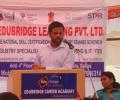
EduBridge is emerging as a strong player in training unemployed youth.

The National Innovation Foundation India (NIF), Ahmedabad shared the ideas that shined at the IGNITE 2015.

Karthik Balakrishnan, an engineering student from Bangalore spearheaded the campaign that will inspire and educate millions from across the country.

Overseas education consultant NNS Chandra shares advice on how to pick the right international education.

'I always say I am a teacher by choice and an entrepreneur by chance.'

Bezos wears it on his sleeve, Nadella keeps it quiet

Sarvesh Agrawal tells Shobha Warrier about how he built a start-up "of the interns, by the interns and for the interns."

Pradip Burman belongs to one of India's most illustrious business families, one which runs the noted Dabur brand of mostly Ayurveda-based FMCG products.

Admittedly, EVMs too have a UID number and any convergence of data can make the secret ballot system a party of history, warns Dr Gopal Krishna in the 5th part of his series against Aadhaar.

Overseas education consultant NNS Chandra offers advice on everything you need to know about pursuing an international education.

In his first attempt, Chirag Jha, a BTech student from the IIT-Bombay scored a perfect 100 in the CAT 2015 results declared earlier this year.

Former President A P J Abdul Kalam kindly answered rediff.com's questions for an exclusive interview.

For the first time in our economic history a government has thought about more than 50 per cent of our economic activity instead of the five per cent represented by the Sensex companies, observes IIM-B professor R Vaidyanathan.

In 2002, at 13 she lost both her hands and severely damaged her legs in a freak accident. Today she is a dedicated social worker, a motivational speaker and model for accessible clothing in India.

Fashion graduate Natasha Ramachandran tells us how she became a model and why the industry is not meant for everyone.

India Inc has few leaders who are likely to grab headlines in 2015.
.jpg)
Ayurvedic expert Dr G G Gangadharan on how the ancient Indian medical practice needs to be propagated in the country of its origin

Frilp will help you discover and share valuable information through word-of-mouth recommendations.

How many of these will you include in your travel list for 2016?

How many of these have you tried already?

"The mountains I climbed, the butterflies I counted, the streams I swam, the jungles I walked along, all called me back. The urge to go back to nature was very strong," says Tibin Parakal from Trissur who quit a lucrative engineering job in Delhi to start a restaurant but then ultimately became a farmer.

'The unique achievements have been made by engineers from small towns who have had a non elite upbringing and who have grown with the programme,' says R Aravamudan, one of the pioneers of the Indian space programme.

It has already tasted success with the moon mission and Mangalyaan. Is man in space the next frontier for ISRO?

Designer Runa Ray, whose edgy line inspired by an ancient discipline made it to the February New York Fashion Week, discussed the showing with Tista Sengupta/Rediff.com

With prices unlikely to run up sharply, genuine buyers can start readying deals before the festival season starts.

ISRO's expedition to Mars is yet another breathtaking adventure for an organisation created by Dr Vikram Sarabhai and carefully nurtured by scientists like A P J Abdul Kalam and R Aravamudan.

Creative and confident, these emerging fashion designers are the future of Indian fashion.
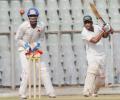
Led ably by Shardul Thakur, Mumbai bowlers put up a much better display than the previous game and shot out Railways for a paltry 217 on day one of their four-day Group 'B' Ranji Trophy tie at the Wankhede Stadium, in Mumbai, on Sunday.
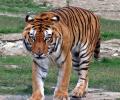
'We are rushing to 'develop' without carefully valuing natural areas.' 'With careful land use planning and scientific zonation at least 5 to 10 per cent of the country's land can be secured for tigers and other such species, and another 5 to 15 per cent kept under low-impact uses to support biodiversity that can coexist with human uses.'
